Search This Blog

Showing posts with label Simplification. Show all posts

Monday, November 11, 2013

Simple Color Themes

Maurice often used simple color themes when designing his films. Many times he would carry variations of a single theme throughout an entire film. For each sequence he would often make one or another color from a color chord the dominant color. For example the blue accent of an earlier sequence may become the dominant color of a later sequence. In some of these examples Maurice has mixed things up with a yellow accent.

A rectangular color chord from "Much Ado About Nutting." (1953)

Supplement to pg. 104 of The Noble Approach.

Monday, September 9, 2013

Cool and Warm Shadows

Maurice often combined cool shadows with warm light. (...as well as warm shadows with cool light.) He would push these contrasts depending on the needs of the story at hand. For example, a more dramatic moment, or a more satirical story would get a more "pushed" treatment. 

Above: Here are a few random examples from some of Maurice's film work showing how he combined light and shadow.

Supplement to pg. 100 of "The Noble Approach"

Monday, September 2, 2013

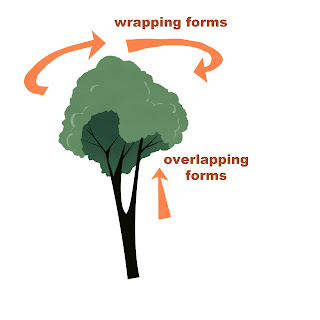
Simplifying Complex forms: Wrap and Overlap


-Many times Maurice used simple geometric shapes when simplifying trees. Often he created added interest by using overlapping and wrapping forms. Frequently accentuating these forms by using slight up or down camera angles. 


From "Much Ado About Nutting" (1953)

In simplifying trees Maurice said; "Use a simple basic shape (circle, square, etc.) as a rough guide. Then add leaves, branches, to give your tree a more natural feel... always try to show the object you are designing from various angles: front, side, and back... remember there are three dimensions. Even in a highly stylized film, you want your elements to sit in space. Use overlapping forms and lines that describe the form to give a sense of dimension."

Supplement to pg. 97 of The Noble Approach

Wednesday, August 28, 2013

Book review from Cartoon Brew!

Amid Amidi at Cartoon Brew discusses "The Noble Approach." You can read his thoughts HERE!


A Personal Note:
In this review Amid discusses Robert J. McKinnon's biography of Maurice "Stepping Into the Picture: Cartoon Designer Maurice Noble." He calls the biography "a failure." I can't agree. To an animation fan expecting lots of art and technique I can see how the book might be disappointing. In fact McKinnon tried to fill the book with art, but was essentially frustrated by Warner Bros. This is a book about Maurice's life. To those of us that knew him it's a gem. I've read the book several times. and despite whatever faults it may have; it's the closest thing I have to the memories of sitting down with Maurice and listening to his stories. Stories that very well may have been lost to the ages without McKinnon's text. -tod

Thursday, August 22, 2013

Steal Wool Progression


A Maurice progression from "Steal Wool." (1957)

(top) A rough layout - Used as reference by the animator.

(center) A color sketch... used as reference for the background painter.

... And the final background painted by artist Phil DeGuard referencing Maurice's final pencil layout, as well as the color sketch.


This background was then tested under camera with a simple character cel set-up. The resulting film frames were reviewed by Maurice to see if everything was working. If you look closely you can see the grease pencil line Maurice made through the above rejected test. He made changes to the set-up and re-shot it. Once everything looked ok... he proceeded to design and test the rest of the film.

Wednesday, August 21, 2013

Simplifying Complex Forms 003

Above: A simplified pan from "Much Ado About Nutting." (1953)

-The "cloud method" is another way Maurice used to simplify tree shapes. He taught, "You can get a lot of  ideas for tree shapes and tree groupings by simply looking at clouds." 


Below: A few of Maurice's layouts from "Wild Over You" (1953) that have been broken down into simple shapes.


Supplement to page 97 of "The Noble Approach."


Tuesday, August 20, 2013

Simplifying Complex Forms 002

-In many his early compositions, and much of his own personal art Maurice used a more "naturalistic" approach to simplification. Though less stylized, he still still broke complex masses, such as trees and leaves, into simple design and pattern. He said; "Understanding growth patterns through observation is the first step to simplifying an object." 

Good examples of this can be found in design books such as "Line and Form"  (1900) by the brilliant English artist Walter Crane
Walter Crane wrote: "... we should want to dwell upon its typical character and form, the controlling lines of its masses, rather than its accidental aspects, because it would really be only with these that we could successfully deal in adapting anything in nature to the conditions and limitations of a design."

Supplement to pg. 97 of The Noble Approach